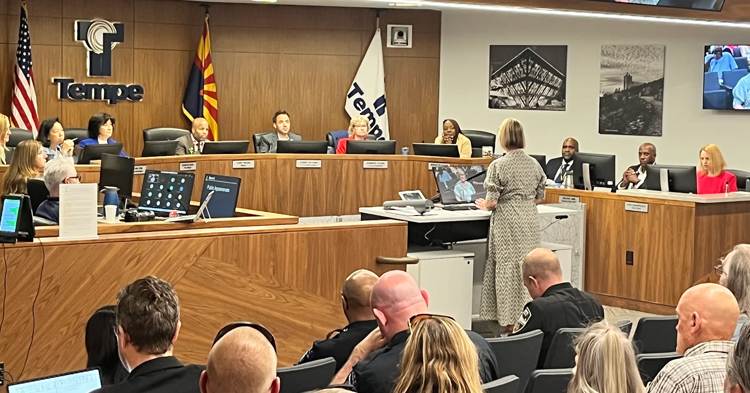
First Things First regional council member Dr. Katie Sprute was preparing to speak before the Phoenix City Council last month and knew she wanted to share her family’s experience with child care.
“I had one infant and one child in care,” she told the city council. “The cost was nearly equivalent to our mortgage. More than half of Phoenix children live in households earning below 185% of the federal poverty level. For many families, child care is simply unattainable.”
The city council was considering allocating $5 million in its 2026 budget to a pilot program to explore ways to reduce child care costs for families in the city.
First Things First (FTF) recently collaborated separately with the cities of Phoenix and Tempe on 2 potential local investments in early childhood education. The Phoenix City Council voted to include the $5 million in its budget at the meeting where Sprute gave her testimony. There is potential for a public-private partnership pilot to gauge the interest in offsetting the costs for employees that companies are trying to retain.
FTF staff worked with Phoenix Mayor Kate Gallego’s office to support coordinated discussions before the vote, said FTF Senior Director of Government Affairs Joe Barba. By meeting directly with city council members to discuss the importance of investing in early childhood and attending community feedback forums, FTF and advocates learned from parents and city residents which topics they were prioritizing.
“Concerns over child care were brought up many times during those conversations,” Barba said. “As we look at the funding decline that FTF is facing and we continue to work on a solution, there’s a balance of working with our municipal partners to help bridge some of the gaps.”
Tempe proposes sales tax increase
In a neighboring city, the Tempe City Council recently advanced a proposal to put a 0.5% sales tax increase before voters in November. Child care and preschool education would receive 0.1%, 0.3% would go for public safety and 0.1% for transportation.
FTF hosted a site tour of a Tempe preschool that could benefit from the new funding and worked with a local city councilman and the Health and Human Services department. As FTF explores these types of municipal partnerships across Arizona, advocates like Sprute and others serve a critical role.
“These advocates are people who care about the issue and can speak about the needs that the early childhood system is facing,” Barba said. “Katie is a resident of Phoenix and can speak about her personal experience with child care. These stories resonate and reinforce the importance that this is a kitchen table issue, affecting families and ultimately, Arizona’s economy.”
Advocacy comes in different ways
Advocacy comes in many forms, said Sprute, who is a member of the FTF Phoenix North Regional Council.
“It doesn’t have to be going in front of the city council in person. There are options such as attending virtually,” she said, which is how she participated that day. “Then there’s also the option of just providing a written statement to the council or at the state level to their state representative or senator.”
For her time before the Phoenix City Council, Sprute’s computer camera was off. “It’s not like my face was on a big screen, but they were listening to me.”
She leaned on her family’s personal story after she had her second child. As working parents, she and her husband knew firsthand the financial burden of finding child care for an infant and a toddler. “For those years, it was like having a second mortgage,” she said.
Luckily for Sprute, who is an early childhood education professor at Grand Canyon University, her employer offers employees a pre-tax dependent care benefit where employees pay into it before taxes and it is used to pay for child care. The pre-tax child care account helped make it more affordable.
“My husband and I went back and forth on whether it was financially sound for me to continue to go to work,” she said. “This (benefit) helped us make more sense about me remaining within the workforce. Otherwise, I wouldn’t have been able to do it. Paying for care with pre-tax dollars reduced our overall tax liability and left more money available for other family expenses.”
It’s these types of family-friendly policies that FTF advocates to policymakers and business leaders in Arizona.
Finding your voice
“One of the great things about FTF is that it is helping people find their voice and an avenue to advocate where they would be most comfortable. Maybe it’s an op/ed in the newspaper or written testimony,” she said.
It could also be sharing about the importance of early childhood education on neighborhood social media pages, which Sprute does frequently in neighborhood mom groups on Facebook.
“The other key part is that really, child care is an infrastructure issue,” Sprute said.
“Once we started to engage more with business leaders, and sharing with them the economic impact of child care issues among the workforce, and the number of women who are most frequently leaving the workforce to care for their families and the economic impact that they’ve had. I think it really helped business leaders start to wrap their heads around the fact that this isn’t just a family issue. This is a business-related issue. And they can start recouping some of the money they lost.”
– Katie Sprute, First Things First regional council member
The Arizona economy loses over $3 billion every year due to reduced earnings for parents who are forced to cut work hours or leave the workforce. It also includes decreased business productivity due to absenteeism and turnover, along with declines in tax revenue from household and business income.
When FTF CEO Melinda Morrison Gulick shared the news at the FTF June Board meeting of the 2 potential local investments in early childhood, she was hopeful.
“No matter what happens, this is evidence of our growing partnerships with municipalities and the growing recognition of the importance of early childhood,” Gulick said.